ATXDMG CASE STUDY REPORT
New Braunfels, Texas Apartment Rental Market
Digital Lead Generation & Occupancy Growth System
1. Executive Summary
The New Braunfels apartment rental market is a rapidly growing suburban housing ecosystem positioned between San Antonio and Austin. The market is driven by population growth, commuter demand, and lifestyle migration rather than purely student housing dynamics.
Property managers in this region face increasing competition from new developments, rising acquisition costs, and growing reliance on third-party listing platforms.
ATXDMG implemented a full-funnel digital leasing system designed to transform apartment communities from passive listing-dependent properties into active, owned lead-generation brands.
The result was a scalable digital infrastructure that increased direct leasing inquiries, improved occupancy consistency, and strengthened long-term brand positioning in a high-growth suburban market.
2. Market Overview
New Braunfels represents a hybrid rental market influenced by:
- Rapid population growth from Austin and San Antonio expansion
- Strong commuter housing demand
- Family-oriented and lifestyle-driven renters
- Increasing influx of remote workers
- A growing pipeline of new apartment developments
Unlike student-dominant markets, New Braunfels is shaped by stability-seeking renters prioritizing space, amenities, and community quality.
3. Business Challenge
Prior to implementation, apartment communities in New Braunfels experienced the following structural challenges:
3.1 High Development Competition
- Rapid increase in new apartment construction
- Market saturation in mid-to-high tier rental segments
3.2 Platform Dependency
- Heavy reliance on Apartments.com, Zillow, and Rent.com
- Limited direct brand-controlled traffic sources
3.3 Rising Acquisition Costs
- Increased cost per lease due to competitive bidding on ads
- Inefficient targeting leading to low-intent traffic
3.4 Weak Local SEO Visibility
- Poor ranking for high-intent search queries
- Underutilized Google Maps presence
3.5 Inconsistent Occupancy Cycles
- Slower leasing velocity in non-peak relocation seasons
- Lack of predictable inbound lead flow
4. Objectives
The engagement was designed to:
- Build a direct-to-consumer digital leasing acquisition system
- Increase qualified renter leads from search and social channels
- Reduce dependency on third-party listing platforms
- Improve occupancy stability across seasonal fluctuations
- Lower cost per lease acquisition over time
- Establish strong digital brand differentiation in a competitive suburban market
5. Strategic Framework (ATXDMG System Architecture)
ATXDMG deployed a five-layer digital transformation model tailored to suburban rental ecosystems.
5.1 Market Intelligence Layer
- High-intent keyword mapping (e.g., “apartments in New Braunfels TX”)
- Competitor density and pricing analysis across new developments
- Migration trend tracking from Austin and San Antonio
- Identification of renter personas: families, remote workers, commuters
5.2 Local SEO Domination System
- Google Business Profile optimization for apartment communities
- Geo-targeted landing pages for neighborhoods and developments
- High-intent keyword targeting for suburban rental searches
- Google Maps ranking optimization for “apartments near me” queries
- Authority-building content focused on lifestyle and relocation intent
5.3 Paid Acquisition Engine
- Google Search Ads targeting high-intent relocation keywords
- Meta Ads targeting families, professionals, and relocating renters
- Retargeting campaigns for website and listing visitors
- Conversion-focused campaigns promoting availability and tours
- Funnel segmentation based on lifestyle and budget preferences
5.4 Conversion System (Website + Funnel Infrastructure)
- Mobile-first apartment leasing websites optimized for speed and clarity
- Virtual tours and lifestyle-driven visual storytelling
- Simplified inquiry flows (“Schedule a Tour” / “Check Availability”)
- Automated routing of leads to leasing teams
- UX optimization focused on trust and decision confidence
5.5 Automation & CRM Layer
- Automated SMS and email nurturing sequences
- Lead scoring based on intent signals and engagement behavior
- Leasing agent notification workflows
- AI-assisted inquiry response systems
- Full pipeline tracking from inquiry to signed lease
6. Technology Stack
The system was built using scalable marketing and automation infrastructure including:
- Google Ads and Meta Ads Manager
- WordPress and Webflow development platforms
- CRM systems similar to HubSpot and Zoho workflows
- Google Business Profile optimization tools
- GA4 analytics and conversion tracking systems
7. Results and Performance Impact
Following implementation, apartment communities experienced:
- Increased volume of direct leasing inquiries
- Reduced reliance on third-party listing platforms
- Higher conversion rates from paid acquisition campaigns
- Improved Google Maps visibility for local apartment searches
- More consistent inbound lead flow across seasonal cycles
- Stronger brand recognition in the New Braunfels rental market
8. Business Impact
The transformation created a structural shift in leasing operations:
- Transition from listing-dependent acquisition to owned demand generation
- Lower long-term cost per lease acquisition
- Improved occupancy stability in both peak and off-peak seasons
- Increased efficiency through automated follow-up systems
- Scalable framework adaptable across multiple properties and developments
9. Key Strategic Insight
In suburban growth markets like New Braunfels, leasing success is no longer defined by property availability alone.
It is defined by digital demand ownership across:
- Search visibility
- Local map rankings
- Paid acquisition systems
- Conversion-optimized digital experiences
- Automated lead nurturing pipelines
Properties that control these systems consistently outperform competitors dependent on third-party listing ecosystems.
10. Replication Framework (Scalability Model)
This system is fully replicable across:
- High-growth suburban markets in Texas
- Commuter corridor cities between major metros
- New apartment development corridors
- Mixed-family and lifestyle rental communities
- Regional multi-property management portfolios
End of Report
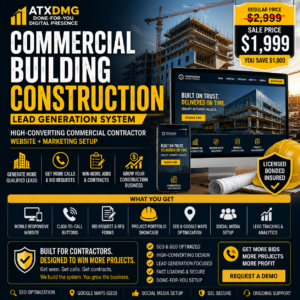 COMMERCIAL BUILDING CONSTRUCTION LEAD GENERATION SYSTEM
1 × $1,999.00
COMMERCIAL BUILDING CONSTRUCTION LEAD GENERATION SYSTEM
1 × $1,999.00