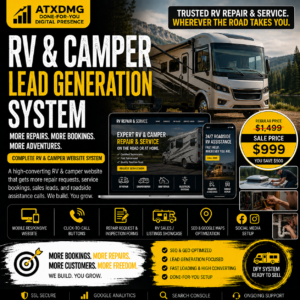
 RV & CAMPER COMPANIES + REPAIR LEAD GENERATION SYSTEM
 Subtotal: $999.00
Wash-N-Fold Business Using Public Laundromat Network Model
Case Study: Wash-N-Fold Growth & Automation System (Public Laundromat Network Model – San Marcos, Texas Market)
ATXDMG Full-Stack Operations, Brand Expansion & Digital Infrastructure System
This case study outlines a scalable business system built for a Wash-N-Fold service operating through existing public laundromat infrastructure in the San Marcos, Texas market.
Instead of building a standalone facility, this model transforms shared laundromat capacity into a high-efficiency, service-based laundry brand layered on top of existing public laundromats.
The result is a low-capital, high-scaling laundry operation powered by branding, logistics, automation, and digital customer systems.
Business Objective
The objective of this system is to build a centralized Wash-N-Fold brand that operates across multiple public laundromats while controlling:
- Customer acquisition
- Pickup and drop-off logistics
- Order management
- Digital booking and tracking
- Subscription revenue
- Local search dominance
- Automated retention systems
This creates a “virtual laundry brand” without needing full ownership of physical infrastructure.
Core Strategy Overview
The system is built on four foundational layers:
- Multi-Laundromat Operational Network
- Digital Booking & Customer Management System
- Pickup, Drop-off & Logistics Layer
- Marketing, SEO & Local Dominance Engine
Each layer works together to create a distributed laundry service platform.
Phase 1: Brand Development & Market Positioning
Objective:
Create a single dominant Wash-N-Fold brand that operates across multiple public laundromats in the San Marcos area.
Components:
- Service positioning as “premium convenience laundry service”
- Brand identity designed for trust and speed
- Clear separation between self-service laundromat customers and Wash-N-Fold clients
- Pricing structure for per-pound service and subscription plans
- Competitive positioning against single-location laundromats and delivery apps
Outcome:
A unified service brand that is not tied to a single physical location but instead operates as a regional service layer across multiple laundromats.
Phase 2: Public Laundromat Integration Model
Objective:
Leverage existing laundromats as processing infrastructure without ownership burden.
Components:
- Partnership agreements with multiple laundromats in San Marcos
- Dedicated Wash-N-Fold processing time windows
- Machine allocation strategy for efficiency
- Overflow distribution between locations based on demand
- Staff coordination system for drop-offs and pickups
- Quality control consistency system across locations
Outcome:
A distributed operational network where multiple laundromats function as processing nodes for a single unified brand.
Phase 3: Digital Booking & Customer System
Objective:
Centralize all customer interactions into a single digital platform.
Components:
- Mobile-first booking website
- Wash-N-Fold order scheduling system
- Pickup and drop-off scheduling interface
- Service pricing calculator (per pound + subscription tiers)
- Customer account system
- Order history tracking
- Payment integration system
- Service area mapping (San Marcos zones)
Outcome:
All customer interactions are controlled digitally, regardless of which laundromat processes the order.
Phase 4: Pickup, Delivery & Logistics Layer
Objective:
Remove customer friction by handling logistics externally to laundromat locations.
Components:
- Pickup scheduling system
- Driver routing and batching system
- Zone-based delivery model (student housing, apartments, residential)
- Same-day and next-day turnaround options
- Delivery tracking updates
- Order batching across multiple laundromats
- Capacity balancing system between locations
Outcome:
A logistics-first Wash-N-Fold system that competes directly with app-based laundry delivery services.
Phase 5: Automation & Customer Lifecycle Engine
Objective:
Increase repeat usage and reduce manual communication workload.
Components:
- Automated SMS pickup confirmations
- Order status notifications (received, washing, completed, out for delivery)
- Subscription reminders (weekly laundry plans)
- Re-engagement campaigns for inactive customers
- Automated review requests after each order
- Loyalty rewards and referral triggers
Outcome:
A self-sustaining customer communication system that drives repeat usage without manual intervention.
Phase 6: Marketing & Local Market Dominance
Objective:
Capture high-intent demand in San Marcos through search and local visibility.
Components:
- Google Search ads targeting Wash-N-Fold and laundry delivery keywords
- Google Maps optimization for service visibility
- Local SEO pages for San Marcos neighborhoods and student housing areas
- Social media targeting for university and apartment populations
- TikTok and Instagram awareness campaigns
- Review generation and reputation scaling system
- Referral campaigns targeting students and renters
Outcome:
Dominance of high-intent local search traffic in a student-heavy, high-turnover market.
Phase 7: Analytics & Multi-Location Optimization System
Objective:
Optimize performance across multiple laundromat partners.
Components:
- Order volume tracking per location
- Capacity utilization across laundromats
- Pickup vs drop-off ratio analysis
- Customer lifetime value tracking
- Subscription conversion tracking
- Delivery efficiency monitoring
- Marketing channel performance analysis
- Regional demand heat mapping (student housing vs residential zones)
Outcome:
Data-driven control over a multi-location service network without owning physical assets.
System Outcome Summary
When fully deployed, this model creates:
- A centralized Wash-N-Fold brand operating across multiple laundromats
- A logistics-driven pickup and delivery service
- A subscription-based recurring revenue system
- A digital-first customer booking platform
- A distributed production network using existing laundromat infrastructure
Revenue streams include:
- Per-pound Wash-N-Fold services
- Subscription laundry plans
- Pickup and delivery fees
- Student housing recurring contracts
- Apartment and property management partnerships
Scalability Model
This system can expand beyond a single city into:
- Multi-city Wash-N-Fold networks
- University-town expansion clusters
- Franchise-style logistics branding
- Regional laundromat partner networks
- Centralized dispatch and processing coordination systems
Each new city becomes a network expansion node rather than a new physical buildout.
ATXDMG Core System Principle
This model demonstrates a scalable transformation framework:
Physical laundromat infrastructure → Distributed service network → Digital booking platform → Logistics layer → Automated revenue engine
Final Outcome
The result is a modern Wash-N-Fold business ecosystem that operates across public laundromats while controlling the customer experience digitally.
It combines:
- Shared physical infrastructure
- Centralized digital control
- Automated customer lifecycle systems
- Logistics-based service delivery
- Search and local market dominance
This creates a scalable, asset-light laundry service model designed for rapid expansion and high-margin recurring revenue growth.