Case Study: Scalable Coin-Operated Laundry Growth & Automation System (Texas Coastal Market)
ATXDMG Full-Stack Launch, Technology, Marketing & Operational Infrastructure Model
This case study documents a complete system design for transforming a traditional coin-operated laundry business into a modern, technology-enabled, delivery-capable, recurring-revenue service business.
The framework is based on a real deployment model in a coastal Texas market and is structured so it can be replicated across similar laundromat and wash-and-fold operations.
Business Objective
The objective of this system is to convert a basic coin-operated laundry location into a hybrid physical + digital laundry platform with:
- High walk-in volume operations
- Subscription-based recurring revenue
- Pickup and delivery logistics
- Automated customer retention
- Strong local search dominance
- App-based customer experience
The result is a business that no longer depends solely on foot traffic, but instead operates as a multi-channel service ecosystem.
Core Transformation Strategy
The system is built around five integrated pillars:
- Brand & Market Positioning System
- Digital Infrastructure (Website + App + CRM)
- Automation & Customer Lifecycle Engine
- Local Search & Marketing Acquisition System
- Delivery & Operations Expansion Layer
Each pillar is required for full system performance.
Phase 1: Market Entry, Positioning & Brand System
Objective:
Reposition a commodity laundromat into a modern convenience-based laundry service platform.
Components:
- Service segmentation (coin-op, wash & fold, pickup & delivery)
- Customer segmentation (residential, students, Airbnb hosts, working professionals)
- Pricing structure design (single-use + subscription models)
- Competitive positioning against legacy laundromats and app-based laundry services
- Brand identity built around speed, convenience, and automation
Outcome:
The business transitions from “self-service laundry” to a managed service utility brand.
Phase 2: Digital Infrastructure System (Website + Customer Flow Engine)
Objective:
Create a centralized digital system that captures, converts, and manages all customer interactions.
Components:
- Mobile-first website designed for service conversion
- Online scheduling for pickup and drop-off
- Service catalog (wash & fold, delivery, subscription plans)
- Real-time booking and availability flow
- SEO-structured service pages for local search dominance
- Click-to-call and instant booking pathways
- Customer onboarding funnel system
Outcome:
The website becomes the primary conversion layer for both walk-in and delivery customers.
Phase 3: Mobile App + Customer Data Ecosystem
Objective:
Turn the laundry business into an app-connected service platform with retention control.
Components:
- Customer mobile application
- Account creation and profile system
- Order scheduling and management
- Real-time order tracking
- Push notification updates (pickup, washing, delivery)
- Digital payment processing
- Loyalty and rewards system
- Subscription management (weekly/bi-weekly laundry plans)
Outcome:
The business shifts from transactional to subscription-driven recurring revenue model.
Phase 4: Automation & Customer Lifecycle Engine
Objective:
Reduce manual labor in communication while increasing repeat usage frequency.
Components:
- Automated SMS reminders for pickup and delivery
- Order status notifications (wash started, completed, en route)
- Re-engagement campaigns for inactive users
- Loyalty reward triggers based on usage frequency
- Automated review request system after service completion
- Subscription renewal reminders
Outcome:
A fully automated customer communication loop that increases retention without additional staffing.
Phase 5: Pickup & Delivery Expansion System
Objective:
Extend revenue beyond physical location limitations.
Components:
- Driver dispatch and scheduling system
- Route optimization and batching logic
- Service zone mapping (delivery radius control)
- Same-day and next-day delivery options
- Subscription-based pickup schedules
- In-app delivery tracking
- Future fleet scaling model
Outcome:
The business evolves into a logistics-enabled laundry service platform.
Phase 6: Marketing & Local Acquisition System
Objective:
Dominate local demand capture and convert high-intent search traffic into customers.
Components:
- Google Search ads targeting high-intent keywords (laundry near me, wash and fold, pickup laundry)
- Google Maps optimization and ranking system
- Local SEO service pages for each offering
- Social media geo-targeted campaigns
- TikTok and Instagram awareness campaigns
- Review generation and reputation system
- Referral and customer incentive programs
- Seasonal marketing campaigns (students, holidays, apartment relocations)
Outcome:
Consistent inbound customer flow driven by search + map + social visibility dominance.
Phase 7: Analytics & Performance Intelligence System
Objective:
Turn operational data into continuous business optimization.
Components:
- Daily order volume tracking
- Pickup vs walk-in ratio analysis
- Customer lifetime value tracking
- Subscription conversion tracking
- Marketing channel ROI breakdown
- Delivery efficiency monitoring
- Peak demand time analysis
- Customer retention and churn tracking
Outcome:
The business becomes data-driven and performance-optimized in real time.
System Outcome Summary
When fully deployed, this model transforms a traditional laundromat into:
- A hybrid physical + digital service business
- A subscription-based recurring revenue platform
- A logistics-enabled delivery operation
- A fully automated customer lifecycle system
- A search-dominant local service brand
Revenue is no longer dependent solely on walk-ins but diversified across:
- Coin-operated usage
- Wash & fold services
- Pickup & delivery orders
- Subscription plans
- Commercial and apartment contracts
Scalability Model
This system is designed to scale into:
- Multi-location laundromat networks
- Franchise models
- Regional delivery expansion zones
- Centralized laundry processing hubs
- White-labeled laundry service apps
Each new location integrates into the same digital infrastructure system.
ATXDMG Core System Principle
This case study demonstrates a repeatable model:
Physical service business → Digital platform → Automated system → Logistics expansion → Data-driven scaling engine
Final Outcome
The transformation produces a modern laundry ecosystem business, combining:
- Physical operations
- Digital customer experience
- Automated retention systems
- Mobile-first booking and tracking
- Delivery-based revenue expansion
- AI-supported marketing and optimization
This creates a scalable foundation for long-term growth, multi-location expansion, and potential franchise development.
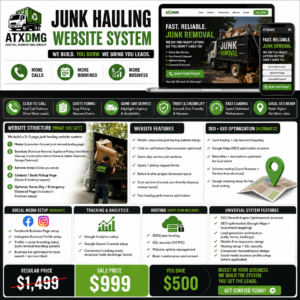 JUNK HAULING LEAD GENERATION SYSTEM
1 × $999.00
JUNK HAULING LEAD GENERATION SYSTEM
1 × $999.00 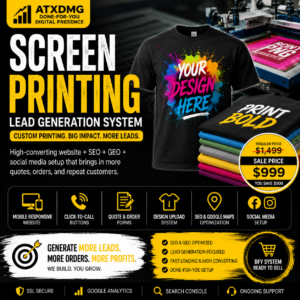 Screen Printing Lead Generation System
1 × $999.00
Screen Printing Lead Generation System
1 × $999.00